
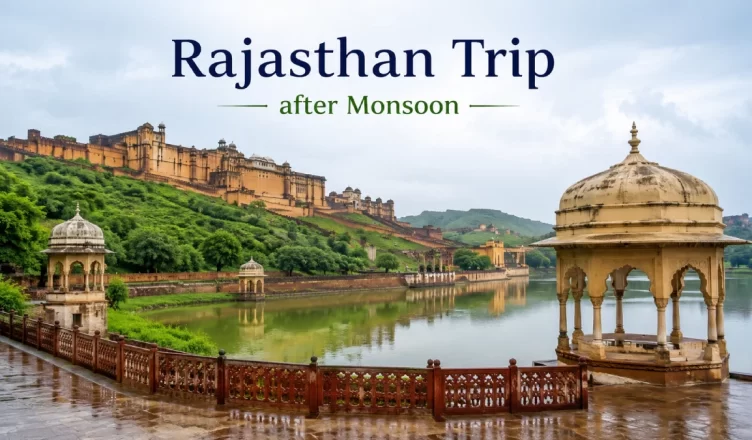
Travelling to Rajasthan just after the monsoon period of July and Augusts opens the fresh beauty of wonderful places as Mount Abu, Udaipur, Bundi, Jaipur. September and October are ideal for a first Rajasthan trip after monsoon to observe the desert green, daytime temperatures cool down to a comfortable 28–34°C, forts and lakes look their best, and the peak-season crowds and prices of November–February haven’t arrived yet. It’s the sweet spot between “too hot” (April–June) and “too busy” (winter).
Who This Guide is For?
If you’re Googling “best time to visit Rajasthan for the first time,” you’re probably picturing camel safaris in Jaisalmer, the Pink City’s bazaars, and Udaipur’s lakes- but you’re unsure whether to book now or wait for winter. This guide answers that exact question: should a first-timer travel in September–October, and what should they actually expect on the ground?
Why the Monsoon Matters More Than You Think?
Rajasthan is a desert state, and most of the year it looks the part-dry, dusty, and unforgiving under the sun. But the monsoon (roughly July to mid-September) changes the landscape completely. Lakes that had shrunk to puddles fill back up, the Aravalli hills around Udaipur and Mount Abu turn a deep green, and the usually parched countryside around Jodhpur and Bikaner briefly becomes soft and scenic.
Travel right after this monsoon window and you get a version of Rajasthan that most photographs don’t show you: full lakes, dramatic skies, and a landscape that feels alive rather than baked. This is one of the most underrated reasons to take a Rajasthan tour package from Delhi for September rather than waiting until December.
What the Weather Actually Feels Like?
- September: Occasional light showers in the first half, humidity tapering off by the third week. Daytime highs around 32–35°C, evenings pleasant.
- October: This is when Rajasthan really opens up. Skies clear, humidity drops sharply, and daytime temperatures settle into a comfortable 28–33°C with cool mornings and evenings-perfect for walking around forts and markets without exhaustion.
Compare that to April–June, when Rajasthan regularly touches 42–46°C, and it’s easy to see why September–October is the more forgiving entry point for someone visiting the state for the first time.
Fewer Crowds, Better Value
Winter (November to February) is Rajasthan’s official high season-every hotel, every guide, every camel-safari operator knows it, and prices reflect that. September and October sit just before this rush:
- Hotel rates in Jaipur, Udaipur, and Jaisalmer are noticeably lower than peak winter rates.
- Popular sights like Amber Fort, City Palace Udaipur, and Mehrangarh Fort are far less crowded, which matters a lot for photography and for actually hearing your guide.
- Tour operators and drivers have more flexibility with itineraries since demand hasn’t peaked yet.
For a first visit, this combination-good weather, thinner crowds, lower cost is difficult to beat. Even this season is also perfect time to plan India Tour.
Festival Season Begins
Late September through October also marks the start of Rajasthan and North India’s festival calendar. Depending on your exact dates, your trip could overlap with Navratri, Dussehra, or the early preparations for Diwali. Markets in Jaipur and Udaipur come alive with lights, sweets, and seasonal shopping-a cultural bonus that winter travellers, arriving after the festivities, often miss.
Which are the best places to visit in Rajasthan after Monsoon?
For someone visiting Rajasthan for the very first time, the classic loop still works best in this season:
1. Jaipur — The Pink City is the natural starting point, easily combined with Delhi and Agra on a Golden Triangle tour. Amber Fort, Hawa Mahal, and City Palace are all comfortable to explore in October’s mild mornings.
2. Jodhpur — The Blue City, dominated by Mehrangarh Fort, is dramatically photogenic after the monsoon when the surrounding hills still hold some green.
3. Udaipur — This is where post-monsoon timing pays off the most. Lake Pichola and Fateh Sagar are full, boat rides are at their scenic best, and the City Palace reflection in the water is picture-perfect.
4. Jaisalmer — If your itinerary stretches further west, October is early enough to enjoy the Thar Desert without June-level heat, making camel safaris and desert camps genuinely enjoyable rather than a heat-endurance test.
5. Mount Abu- Mist-covered hills, Boating on Nakki Lake, fresh mountain views of Aravalli Hills and lush green forests in surrounding make it most suitable destination in Rajasthan.
A well-paced heritage tour package covering these four cities over 7–8 days gives first-timers a complete sense of Rajasthan’s forts, lakes, and desert without rushing.
Practical Tips for First-Time Visitors
- Pack light layers. Mornings and evenings in October can be cool enough for a light jacket, while afternoons still call for cottons.
- Carry rain-ready essentials only for early September. By the third week, rain becomes rare.
- Book accommodation 3–4 weeks ahead, especially if your travel dates overlap with Navratri or Dussehra, since local festival travel picks up.
- Prioritise comfortable footwear. Forts like Amber and Mehrangarh involve significant walking on uneven stone.
- Hire a private vehicle rather than relying on local transport hops between cities-Rajasthan’s distances are large, and a car rental with driver or a Urbania tempo traveller on rent for group travel makes the Jaipur–Jodhpur–Udaipur–Jaisalmer circuit far less tiring.

Budget: What Changes Between September–October and Peak Winter
Money is often the deciding factor for first-time travellers choosing when to go, so it’s worth breaking down where the shoulder-season savings actually show up:
- Accommodation: Heritage hotels and palace properties in Udaipur and Jodhpur that charge premium winter rates typically drop 20–35% in September–October. Even mid-range hotels in Jaipur follow this pattern.
- Transport: Private car and driver rates stay fairly stable year-round, but availability is easier to book on short notice in the shoulder season, which can mean better vehicle options for the same price.
- Guides and local experiences: Camel safaris, boat rides, and local guides in Jaisalmer and Udaipur have more flexibility on group sizes and timings when demand is lower, which often translates into a more personalised experience rather than a discounted one.
- Flights: If you’re flying into Jaipur or Udaipur rather than driving from Delhi, September–October fares tend to sit below the November–January spike, though this varies week to week.
For a first-timer testing whether Rajasthan matches expectations before committing to a longer or repeat trip, this combination of lower cost and better on-ground flexibility makes the post-monsoon window a genuinely practical choice, not just a weather one.
What Surprises Most First-Time Visitors
A few things tend to catch new travellers off guard, and knowing them in advance smooths the trip considerably:
- Distances are bigger than they look on a map. Jaipur to Jodhpur is close to 6 hours by road, and Jodhpur to Udaipur is another 5–6 hours. Rajasthan rewards travellers who build in realistic driving time rather than trying to cover too much too fast.
- Forts involve serious walking and stairs. Amber Fort, Mehrangarh, and Chittorgarh are enormous complexes built for defence, not convenience. Comfortable shoes matter more here than in most other parts of a North India itinerary.
- Bargaining is expected in bazaars, but not at fixed-price emporiums or government-run craft centres. Knowing the difference in advance saves awkward moments.
- Desert nights are cooler than expected, even in October. A light jacket for evening camel safaris and desert camps is worth packing even though daytime temperatures are pleasant.
A Note on Culture Beyond the Big Forts
Rajasthan’s appeal isn’t limited to its palaces. If you have an extra day or two, consider stepping off the standard circuit- smaller towns and rural experiences around the state offer a different, quieter side of Rajasthan than the fort-and-bazaar itinerary most first-timers stick to.
Our related read on foreign traveller experiences beyond the Taj Mahal touches on similar under-the-radar spots across North India worth building into a longer trip.
Food Worth Planning Around
Rajasthani cuisine is reason enough to build extra time into your itinerary. Dal baati churma in Jaipur, the rich ker sangri (a desert bean and berry dish) in Jodhpur, and Udaipur’s lakeside cafés serving both local thalis and international menus round out a trip that isn’t just about forts and photographs. September–October’s milder weather also makes it far more comfortable to sit at an open-air rooftop restaurant in the evening than it would be during summer’s heat or winter’s chillier nights.
Suggested Read: Best Places to Visit in India in October
Frequently Asked Questions
Is September too early to visit Rajasthan because of the monsoon?
By the first week of September, most of Rajasthan has already received its main monsoon rainfall, and showers become sporadic. Light rain is still possible in early September, but it’s usually brief and doesn’t disrupt sightseeing. By late September, most regions are essentially dry.
Is October better than September for a first Rajasthan trip?
Yes, generally. October offers more consistently dry weather, lower humidity, and cooler evenings than September, making it the more comfortable of the two months for extensive sightseeing and desert excursions.
Will I still see green landscapes in October, or does everything dry out immediately?
Some of the post-monsoon greenery, especially around Udaipur and Mount Abu, lasts well into October before the desert climate reasserts itself. By November, the landscape reverts closer to its typically arid look.
Do hotel and package prices actually drop in September–October compared to winter?
Yes. September and early October fall in Rajasthan’s shoulder season, before the November–February peak. Hotels, resorts, and tour packages are typically priced lower during this window, and availability is easier to secure on short notice.
Is it safe to do a desert safari in Jaisalmer in October?
October is one of the better months for desert safaris-daytime heat has eased considerably from summer levels, and nights in the desert are pleasantly cool rather than uncomfortably cold, unlike peak winter (December–January) when desert nights can get quite chilly.
How many days do I need for a first Rajasthan trip covering Jaipur, Jodhpur, and Udaipur?
A comfortable first-timer itinerary needs 6–8 days for these three cities, including travel time between them. Adding Jaisalmer for a desert experience typically extends the trip to 9–10 days.
Can I combine Rajasthan with Delhi and Agra in one trip?
Yes-this is the classic Golden Triangle extension, pairing Delhi’s monuments and Agra’s Taj Mahal with Jaipur before continuing deeper into Rajasthan. It’s one of the most popular ways for first-time visitors to experience North India in a single trip.
Ready to plan your post-monsoon Rajasthan trip? Explore our Rajasthan tour packages from Delhi or get in touch to build a custom itinerary around your dates.
One thought on “Rajasthan Trip After Monsoon: Why September–October Suits First-Time Visitors Best”