
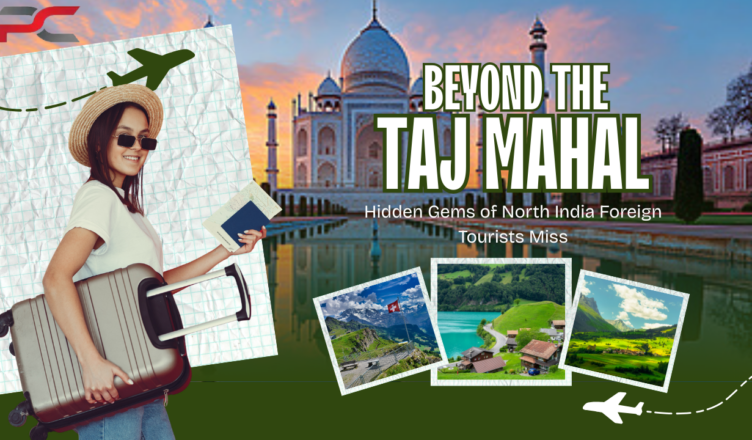
Every year, millions of foreign tourists land in India and follow roughly the same well-worn trail: Delhi to Agra for the Taj Mahal, then across to Jaipur for the pink palaces. The Golden Triangle. It is magnificent, genuinely- few itineraries on earth pack three cities of such grandeur into three days. But there are much more to explore beyond the Taj Mahal, that nobody tells you before you board your flight: the Taj Mahal, extraordinary as it is, may not even be the most remarkable thing within a five-hour drive of where you are standing.
North India is one of the most historically layered, culturally complex, and geographically dramatic regions on earth. The Himalayas. The Gangetic plains. Ancient university ruins. Living medieval cities. Temples carved into single cliffs. Valleys where Tibetan culture thrives. Bazaars unchanged since the Mughal era. Most foreign visitors return home having seen perhaps 3 per cent of it.
This guide is for the other 97 per cent. Here is what North India’s most curious and rewarding destinations look like- and why they deserve a place on every serious international traveller’s itinerary.
The Golden Triangle Problem- and What Lies Beyond It
The Delhi–Agra–Jaipur circuit exists for good reason: these are three of India’s most visited and most rewarding cities, and for a first-time visitor with limited time, the Golden Triangle Tour India delivers an efficient and genuinely impressive introduction to Mughal architecture and Rajput grandeur. But it has also created a distorted mental map of North India in the minds of most international travellers- one in which the region between and beyond these three cities simply does not exist.
What actually lies beyond? An almost overwhelming richness. Within a single day’s drive of the Golden Triangle sits Fatehpur Sikri- a complete Mughal capital city abandoned after only 14 years and frozen in extraordinary red sandstone. Nearby Orchha, a 16th-century Bundela kingdom capital, has palaces, cenotaphs, and temples that rival anything in Jaipur, yet sees a fraction of the visitors. The sacred city of Varanasi- perhaps India’s most profound urban experience for foreign visitors is just six hours from Agra but missed by the majority of those who come to see the Taj.

The pattern repeats across the region. International tourists concentrate in a handful of well-marketed sites and miss the extraordinary depth that surrounds them. What follows is a corrective- a guide to eleven North Indian experiences that deserve far more attention from the world’s travellers.
What Foreign Tourists Are Missing- Gem by Gem
01 🏰 Orchha- The Forgotten Royal Capital
Madhya Pradesh · 5 hrs from Agra · Zero crowds
If you told most foreign visitors that there is a medieval city of palace complexes, riverside cenotaphs, and ornate temples sitting largely unvisited on the banks of the Betwa River, just five hours from the Taj Mahal, they would not believe you. Orchha is that city that is worth visit beyond the Taj Mahal to see ad explore. Built by the Bundela kings from the 16th century onward, Orchha’s Jahangir Mahal, Raja Mahal, and Chaturbhuj Temple represent some of the finest examples of Rajput-Mughal architecture in all of India. The cenotaphs (chhatris) of the Bundela kings line the Betwa riverbank in a row of 14 towering structures- elegant, melancholy, and almost always deserted. Wandering through Orchha in the early morning is one of the most atmospheric experiences North India has to offer.
02 🎨 Shekhawati — The Open-Air Fresco Museum
Rajasthan · 3–4 hrs from Jaipur · Unique globally
The Shekhawati region of northeastern Rajasthan contains what travel writers have called the world’s largest open-air art gallery- a network of small towns where the merchant havelis (mansions) of the 19th century are covered floor-to-ceiling, inside and out, with extraordinary painted frescoes. The towns of Mandawa, Nawalgarh, Dundlod, and Fatehpur contain thousands of these painted buildings, depicting everything from Hindu mythology and royal processions to fascinatingly- early encounters with trains, telephones, and automobiles as the merchant families absorbed the novelty of modernity. The frescoes are in varying states of preservation, which only adds to the explorer’s atmosphere. Almost no foreign tourists come here. Almost all who do are stunned.
Find Here: Famous Heritage Sites of India
03 🌊 Varanasi- India’s Most Profound City
Uttar Pradesh · 6 hrs from Agra · Essential for every visitor
It is genuinely puzzling that Varanasi- one of the oldest continuously inhabited cities on earth and arguably India’s most intense and irreducible urban experience is skipped by the majority of international visitors who come to see the Taj Mahal just six hours away. The ghats of Varanasi at dawn, seen from a rowing boat on the Ganges as the city wakes up around you, represent a visual and sensory experience without parallel anywhere in the world. The evening Ganga Aarti at Dashashwamedh Ghat a choreographed ceremony of fire, incense, bells, and chanting conducted by priests in synchronised formation is one of India’s great spectacles. And the ancient lanes of the old city, the silk weavers’ quarters, visit at Kashi Vishwanath Temple and the ghats at every hour of the day offer a depth of experience that simply cannot be compressed into a single visit.
04 ⛰️ Spiti Valley- The Himalayan High Desert
Himachal Pradesh · 2 days from Delhi · Altitude: 3,800–4,500m
While Ladakh has been firmly on the international tourist map for years, its equally dramatic neighbour Spiti Valley remains significantly less visited and significantly more raw. The Spiti River cuts through a landscape of stark, lunar-grey mountains and ancient Buddhist monasteries perched on clifftops at altitudes that make breathing itself feel like an achievement. Key Monastery, Tabo Monastery (over 1,000 years old and considered the Ajanta of the Himalayas), and the fossil-rich village of Langza offer experiences that are genuinely unlike anything else in the world. The night skies above Spiti, far from any light pollution, are among the darkest and most star-filled on the planet. For adventurous foreign travellers, Lahaul Spiti Valley Tour is one of India’s absolute pinnacles.
05 🏛️ Fatehpur Sikri — The Ghost Capital
Uttar Pradesh · 40 km from Agra · UNESCO World Heritage Site
Most visitors to Agra spend their entire time at the Taj Mahal and Agra Fort, then move on, without realising that 40 kilometres to the west sits one of the most remarkable abandoned cities in the world. Fatehpur Sikri was built by the Mughal Emperor Akbar as his new imperial capital in 1571, occupied for barely 14 years, then abandoned- apparently due to water scarcity and frozen in time. The complex combines Hindu, Islamic, and Persian architectural traditions in a way that reflects Akbar’s syncretic religious philosophy and is utterly unique in Mughal architecture. The Jama Masjid, the Panch Mahal, Jodha Bai’s Palace, and the Buland Darwaza gateway are all in remarkable condition. It is a place of profound historical imagination, and it is almost criminally under visited by foreign tourists given its proximity to the Taj. You can explore Fatehpur Sikri with One Day Agra Tour Package from Delhi.
06 🙏 Rishikesh & the Upper Ganga — Yoga’s Birthplace
Uttarakhand · 6 hrs from Delhi · Gateway to the Himalayas
While yoga studios in Rishikesh have become well-known on the international circuit, most foreign visitors still experience only the surface of what this extraordinary river town offers. Rishikesh sits at the point where the Ganges emerges from the Himalayan foothills onto the plains — and the energy of the river here is palpable in a way that is qualitatively different from Varanasi. The world-famous Beatles Ashram (Maharishi Mahesh Yogi’s Chaurasi Kutia) where the Fab Four famously stayed in 1968 is now partially open as an art installation and forest walk. The white-water rafting on the Ganga through the gorges above Rishikesh is among the best accessible river rafting in Asia. And the temple-lined ghats at dusk, as the river turns gold and the evening aarti begins, are as moving as anything in the subcontinent.
07 Jim Corbett National Park- Tiger Country
Uttarakhand · 6 hrs from Delhi · India’s first national park
India’s tiger reserves are among the finest wildlife experiences available to international travellers anywhere on earth yet wildlife tourism in North India remains dramatically underrepresented in most foreign visitors’ itineraries. Jim Corbett National Park, established in 1936 as India’s first national park, protects over 1,300 square kilometres of Himalayan foothills terai and is home to over 215 tigers, leopards, elephants, and over 600 species of birds. A dawn safari through Corbett’s Dhikala zone- bumping along in an open jeep as the forest awakens around you is one of the most viscerally exciting experiences North India offers. For foreign tourists who love wildlife, skipping Corbett in favour of a third visit to a Mughal monument would be a significant miscalculation.
08 Khajuraho- India’s Most Misunderstood Masterpiece
Madhya Pradesh · 7 hrs from Agra · UNESCO World Heritage Site
Khajuraho’s temples are famous internationally- but almost exclusively for the wrong reason. The erotic carvings that cover the outer walls of these 10th and 11th-century Chandela temples represent perhaps 10 per cent of the total sculptural programme. The other 90 per cent- depictions of celestial nymphs, warriors, elephants, deities, and daily life in extraordinary detail represent one of the most refined achievements of Indian temple sculpture anywhere. The larger context of Khajuraho is equally impressive: the temples were built by the Chandela dynasty at the height of their power and rediscovered by a British officer in 1838 having been effectively swallowed by the jungle for centuries. The Sound and Light Show in the temple gardens at night, with the carved stone illuminated against the dark sky, is unforgettable. Khajuraho deserves to be known for its artistry, not its notoriety. You can explore beauty of the medieval city with Khajuraho Travel Guide.
09 🧘 McLeodganj & Dharamshala — Where Tibet Survived
Himachal Pradesh · 12 hrs from Delhi · Tibetan culture in exile
Since the 14th Dalai Lama established his government-in-exile in Dharamshala in 1960, the hill town of McLeodganj has become something extraordinary- a living preservation of Tibetan Buddhist culture outside Tibet. For foreign visitors interested in Buddhism, spirituality, or simply encountering a culture that has refused to disappear, McLeodganj is one of India’s most rewarding family trip destinations. The Tsuglagkhang Temple, the Tibet Museum, morning prayers at Namgyal Monastery, and the remarkable community of Tibetan refugees who have rebuilt their civilization in the Indian Himalayas- all of this is available within a compact, walkable hill town that also happens to offer excellent trekking, yoga retreats, and some of the best cafe culture outside a major Indian city.
Find This: Dharamashala and Mcleodganj Tour Guide
10 🏺 Agra Beyond the Taj — The City Most Visitors Ignore
Uttar Pradesh · In Agra itself · Dramatically underexplored
This one is perhaps the most surprising entry on this list: Agra itself. Most foreign visitors spend their entire time in Agra at the Taj Mahal, devote a couple of hours to Agra Fort, and leave without realising that the city contains several more remarkable monuments within a short distance. Itimad-ud-Daula’s Tomb (the Baby Taj) is a stunning mausoleum in white marble with extraordinarily delicate pietra dura inlay work that in some respects surpasses the Taj itself in its intricacy. The Mehtab Bagh on the opposite bank of the Yamuna offers the finest sunset view of the Taj with virtually no crowds. The Chausath Khamba- a Mughal garden tomb with 64 intricately carved marble columns sits barely a kilometre from the Taj and is almost always empty.
Find Here: Agra and Fatehpur Sikri Travel Guide
11 🌄 Chopta & Tungnath — The Himalayas Without the Crowds
Uttarakhand · 9 hrs from Delhi · Altitude 3,680m
While Shimla and Manali handle millions of tourists annually, the Garhwal region of Uttarakhand contains equally spectacular Himalayan landscapes that see a fraction of the visitors. Chopta — a tiny hamlet at 2,680 metres — serves as the base for the trek to Tungnath, the highest Shiva temple in the world at 3,680 metres, with 360-degree views of Nanda Devi, Trishul, and Chaukhamba. The meadows around Chopta turn gold and crimson in autumn, and the absence of crowds makes the experience feel genuinely wild and untouched. For foreign travellers who love mountain landscapes and want to experience the Himalayas without bus queues and souvenir stalls, Chopta is close to perfect.
Why Foreign Tourists Miss These Places and How to Find Them?
The pattern of what international visitors miss in North India is not random. It reflects the choices made by large tour operators who design packages around certainty- iconic monuments with established infrastructure, standardised itineraries that can be sold to the widest possible market, and minimal logistical complexity. This is understandable commercially, but it systematically excludes everything that does not fit the template.
The solution is straightforward: add at least two days to your India itinerary and allocate them specifically to a destination that does not appear in your operator’s standard brochure. The infrastructure for independent or semi-independent travel in North India has improved dramatically in the past decade. Well-maintained highways, reliable hotel booking platforms, and a growing network of boutique guesthouses and heritage hotels mean that the gap between the well-trodden and the offbeat is far more accessible than it used to be.
Practical Tips for Going Beyond the Golden Triangle
- Add a minimum of 2 extra days to your India itinerary specifically for an offbeat destination
- Hire a Tempo Traveller on rent in Delhi for flexibility- the ability to stop at an unmarked Mughal tomb or a roadside chai stall is worth more than any guided coach tour
- Use overnight trains between cities- the experience itself is a window into Indian life and saves accommodation costs
- Ask your hotel or guesthouse owner for one recommendation that is not in your guidebook- local knowledge consistently outperforms published guides
- Do not over-schedule- the most memorable moments in North India are almost always unplanned
✈️ Best Itinerary Tip: Delhi (2 days) + Agra including Fatehpur Sikri (2 days) + Orchha (2 days) + Varanasi (3 days) is one of the most rewarding 9-day North India itineraries available for foreign visitors and covers both iconic and deeply underrated destinations in a single coherent arc.
Quick Reference — Hidden North India for Foreign Travellers
| Orchha | Forgotten Bundela capital. Palaces, cenotaphs, temples. 5 hrs from Agra. Near zero crowds. |
| Shekhawati | World’s largest open-air fresco collection. 19th-century painted havelis. 3 hrs from Jaipur. |
| Varanasi | India’s oldest city. Ganges ghats. Ganga Aarti. 6 hrs from Agra. Essential for every visitor. |
| Spiti Valley | High-altitude Buddhist desert. Ancient monasteries. 2 days from Delhi. Adventure travel. |
| Fatehpur Sikri | Abandoned Mughal capital. UNESCO. 40 km from Agra. Most accessible hidden gem in India. |
| Rishikesh | Yoga capital. Ganga rafting. Beatles Ashram. 6 hrs from Delhi. Gateway to Himalayas. |
| Jim Corbett NP | Best tiger wildlife in North India. 6 hrs from Delhi. 215+ tigers. Dawn jeep safaris. |
| Khajuraho | 10th-century temple masterpieces. UNESCO. Far more than its famous carvings. MP. |
| McLeodganj | Living Tibetan culture. Dalai Lama’s home. Trekking. Monasteries. 12 hrs from Delhi. |
| Baby Taj (Agra) | Itimad-ud-Daula’s Tomb. Finer inlay than the Taj itself. In Agra — almost nobody goes. |
| Chopta | Highest Shiva temple. Alpine meadows. 9 hrs from Delhi. Zero crowds. Himalayan perfection. |
The India That Waits Past the Postcard
There is a version of North India that exists in travel brochures- magnificent, ancient, photogenic, and entirely real. The Taj Mahal at sunrise. The pink walls of Jaipur. The Red Fort against the Delhi sky. These images earned their place in the imagination of travellers worldwide because they are genuinely extraordinary.
But there is another version of North India- one that most foreign visitors never encounter- where the monuments have no queues and the only sound is wind through ancient stone. Where a medieval city sits frozen in time on a river bend and the guesthouse owner has lived there his entire life. Where the Himalayas rise above a valley so quiet you can hear your own heartbeat. Where an abandoned Mughal capital crumbles magnificently in the afternoon light while a family of langur monkeys picks through the ruins.
Find Here: Popular North India Tour Packages
This version of North India does not require extraordinary effort to access. It requires only a willingness to look past the postcard. Add two days. Take a different road. Say yes when someone suggests something that is not in your guidebook. The Taj Mahal will still be there when you get back. You will appreciate it differently as one extraordinary note in a symphony that is far larger, stranger, and more beautiful than most visitors ever suspect.