
A complete 7-day itinerary, permit guide, budget breakdown, and packing list for Valley of Flowers Trip.
Chamoli District, Uttarakhand | Open July – October
| 500+ Wildflower species | 3,962 m Valley altitude | 8 km Trek into valley | ~500 km From Delhi | Jul–Sep Peak bloom window |
Introduction: India’s Most Beautiful Trek
Tucked deep in the Chamoli district of Uttarakhand, at an elevation of nearly 4,000 metres, the Valley of Flowers National Park is one of those rare places that looks exactly as extraordinary as it does in photographs-and somehow more so in person. Every July, the valley floor erupts in an unbroken carpet of wildflowers: Himalayan blue poppies, brahmakamal (Uttarakhand’s state flower), cobra lilies, yellow compositae, and over 500 species that bloom for their brief Himalayan window before the snows return in October.
Designated a UNESCO World Heritage Site in 2005 as part of the Nanda Devi Biosphere Reserve, the Valley of Flowers is not merely beautiful-it is scientifically significant, home to rare and endangered species found almost nowhere else. For the traveller, it represents one of India’s most rewarding short treks: accessible enough for a moderately fit person, yet remote enough that it demands proper planning.
From Delhi, the journey requires a commitment of 6 to 8 days. The logistics are well-trodden and manageable-but the details matter enormously. This guide covers every aspect of planning your trip: when to go, how to get there, what the trek involves day by day, what permits you need, how much it costs, and what to pack.
When to Go on Valley of Flowers Trip -The Bloom Calendar
The Valley of Flowers National Park is open only between July 1 and October 31 each year. Outside this window, the valley is under snow and the trail is closed. Within the open season, timing matters significantly:
| Period | Status | What to Expect |
| Before July 1 | CLOSED | Heavy snowpack. Park inaccessible. |
| July 1 – July 20 | Early Bloom | Park opens. First flowers. Some snow remains on upper patches. |
| Late July – August | PEAK BLOOM | Best time. 300–500 species in full flower. Maximum colour in the valley. |
| September | Late Season | Fewer flowers but clearer mountain skies. Ideal for photography. |
| After October 1 | CLOSED | Park closes for winter. Snow returns to the valley floor. |
| BEST WINDOW The ideal visit is between July 25 and August 20. This is peak bloom-the Brahmakamal is fully open, the valley is carpeted in maximum colour, and the monsoon rains keep the landscape intensely green. Yes, it rains during this period. Pack accordingly and embrace it. The rain is part of what makes the valley extraordinary. You can also extend your trip with visit to places near Valley of Flowers such as Hemkund Sahib, Badrinath Temple, Nanda Devi National Park, Auli and Joshimath. |
How to Reach Valley of Flowers from Delhi-Transport Options
The Valley of Flowers is approximately 500 km from Delhi. The trek begins at Govindghat in Chamoli district, which is accessible by road via Rishikesh and Joshimath. There are four main transport approaches:
Option 1-By Road (Self-Drive or Hired Vehicle)
The most flexible and popular option for groups. The full journey from Delhi to Govindghat (500 km) is best split across two days: Delhi to Joshimath on Day 1–2, then Joshimath to Govindghat on Day 3 (20 km). A Tempo Traveller on Rent in Delhi or SUV is ideal for mountain roads.
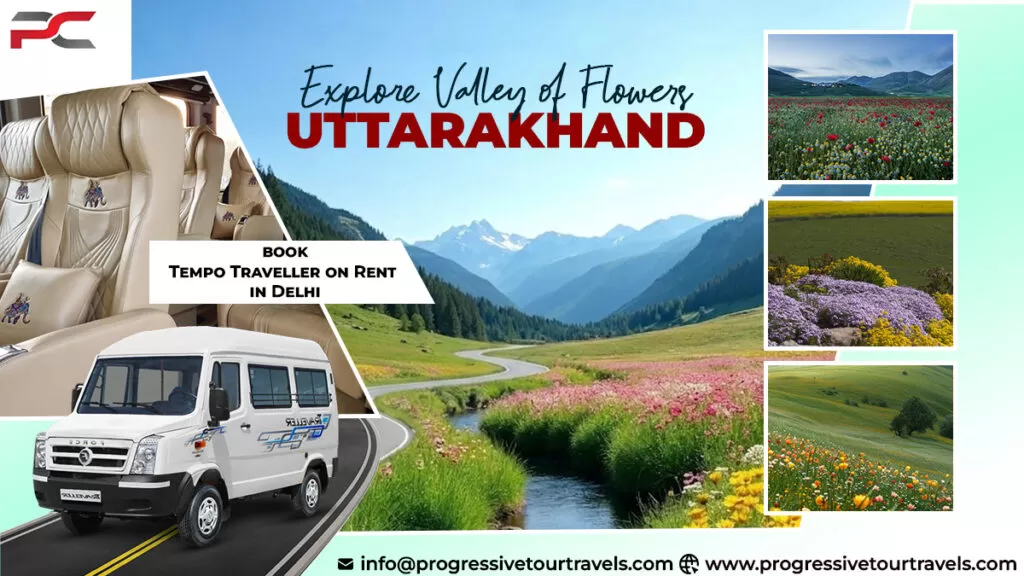
Hiring a 12 Seater Tempo Traveller for a group of 8–12 is the most economical and comfortable approach-total vehicle cost for a 7-day circuit runs Rs. 22,000–35,000.
Option 2-Train to Haridwar + Road
Take the Shatabdi or Jan Shatabdi Express from Delhi to Haridwar (4.5 hrs). From Haridwar, hire a Tempo Traveller or shared taxi to Joshimath (8–9 hrs). This is the most popular option for those who want to avoid the full Delhi–Joshimath drive and prefer the comfort of train travel for the first leg. Distance between Haridwar and Valley of Flowers is 290 km approx that can be covered by road by car rental in Haridwar.
Option 3-Flight to Dehradun + Road
Fly Delhi to Jolly Grant Airport, Dehradun (45-minute flight, frequently available from Rs. 2,500–5,000 one way). From Dehradun, hire a vehicle to Joshimath (280 km, 7 hrs). Best for those with limited time who want to skip the first long drive leg entirely.
Option 4-State Bus (Budget)
Uttarakhand Roadways and GMOU buses run from Haridwar and Rishikesh to Joshimath. Economical but slow and less comfortable on mountain roads. Not recommended for elderly travellers or groups with significant luggage.
Day-by-Day Itinerary: 7-Day Plan from Delhi
| D1 | Delhi to Haridwar / Rishikesh Drive or train-200–240 km Depart Delhi early morning by road (NH-58) or take the Shatabdi Express to Haridwar (4.5 hrs). Overnight in Rishikesh or Haridwar. These are acclimatisation towns, not just transit stops. The Ganga aarti at Har Ki Pauri (Haridwar) or Triveni Ghat (Rishikesh) at dusk is worth timing your arrival for. Explore Laxman Jhula and the market area in Rishikesh in the evening. Night halt: Rishikesh / Haridwar | Altitude: ~350 m |
| D2 | Rishikesh to Joshimath Drive-255 km, 8–9 hours The most spectacular drive of the trip. The road passes through the Panch Prayag confluences-Devprayag (Alaknanda meets Bhagirathi), Rudraprayag, Karnaprayag, Nandprayag, and Vishnuprayag. Each confluence is a distinct shade of river meeting river, worth a 15-minute stop. Depart by 6 AM to reach Joshimath before dark. Joshimath (1,875 m) is the last large town with good accommodation, medical facilities, and ATMs before the trek. Night halt: Joshimath | Altitude: 1,875 m | Key stops: Panch Prayag |
| D3 | Joshimath to Govindghat to Ghangaria Drive 20 km + Trek 14 km Drive from Joshimath to Govindghat (20 km)-the official trailhead. Park your vehicle in the designated GMVN parking area. The trek to Ghangaria is 14 km through the Pushpawati river valley on a well-marked trail through alpine forest. Mules and porters are available at Govindghat. Arrive at Ghangaria (3,050 m) by afternoon-this small settlement is your base camp for the valley. Book accommodation in advance. Night halt: Ghangaria | Altitude: 3,050 m | Trek: 14 km |
| D4 | Valley of Flowers-Full Day Trek 8 km return from Ghangaria The main event. The valley entrance is 4 km from Ghangaria. Collect your entry ticket at the forest gate (open from 7 AM, Rs. 150 for Indians). The valley floor is roughly 8 km long and 2 km wide. Walk as far as fitness and time allow-even the first kilometre into the valley is spectacularly coloured in peak season. Carry a packed lunch; no food stalls inside. Exit before 5 PM when gates close. The Pushpawati river runs through the valley floor-do not wade across. Valley trek: 8 km return | Gate open: 7 AM – 5 PM | Entry ticket required |
| D5 | Hemkund Sahib-Optional High-Altitude Trek Trek 12 km return-altitude 4,329 m Hemkund Sahib, the Sikh pilgrimage shrine at 4,329 metres, is reached by a steep 6 km climb from Ghangaria. One of the highest gurudwaras in the world, set beside a glacial lake ringed by seven snow-covered peaks. The langar served here is both spiritually significant and practically reviving after the climb. Start by 6 AM. Not recommended for those with heart or respiratory conditions. Many visitors add an extra night at Ghangaria between Days 4 and 5. Altitude: 4,329 m | Trek: 12 km return | Strenuous-start early |
| D6 | Ghangaria to Govindghat to Joshimath Trek down + drive back Descend from Ghangaria to Govindghat (downhill trek takes 3–4 hours). Collect your vehicle and drive back to Joshimath for an overnight rest. Alternatively, if time allows, push to Rudraprayag or Srinagar (Garhwal) to break the return drive into two more comfortable legs. Night halt: Joshimath or Rudraprayag |
| D7 | Return to Delhi Drive-300–500 km depending on previous halt Drive back to Delhi via Rishikesh and Haridwar. Allow 9–11 hours from Joshimath, or 6–7 hours if you overnighted in Haridwar. Alternatively, drop the vehicle in Haridwar and take an evening train back to Delhi to arrive refreshed. Night halt: Delhi |
Permits and Entry Requirements
The Valley of Flowers has a streamlined permit system that is handled at the trailhead and valley entrance. Here is a complete overview:
| Permit / Fee | Where Obtained | Cost (Approx) | Notes |
| Valley of Flowers entry ticket | Forest gate at valley entrance | Rs. 150/day (Indian) | Pay daily at gate, open 7 AM |
| Foreign nationals entry | Same gate | Rs. 600/day | Passport required at gate |
| Hemkund Sahib entry | Free-no ticket needed | Free | Gurudwara, donations welcome |
| Nanda Devi Biosphere permit | Forest Dept office, Joshimath | Rs. 200 (Indian) | Required beyond marked trail |
| Ghangaria accommodation | GMVN / private guesthouses | Rs. 600–Rs. 2,500/night | Book ahead in peak season |
| IMPORTANT: REGISTRATION All pilgrims and trekkers must register at the Joshimath Forest Department office or the Govindghat checkpost. Carry a government-issued photo ID (Aadhaar, passport, or driving licence). Foreign nationals must carry their passport. The registration is free and takes 15 minutes. |
Budget Breakdown-Per Person Estimate
The Valley of Flowers can be done across a wide budget range. Here is a realistic breakdown per person, assuming a group of 8–10 sharing vehicle and accommodation costs:
| Expense Head | Budget | Mid-Range / Comfortable |
| Transport (Delhi–Delhi, shared) | Rs. 2,500–3,500 | Rs. 4,000–6,000 |
| Accommodation (6 nights) | Rs. 3,600–5,400 | Rs. 7,200–12,000 |
| Meals (7 days) | Rs. 2,000–3,000 | Rs. 3,500–5,000 |
| Entry permits & tickets | Rs. 500–800 | Rs. 500–800 |
| Porter / mule (optional) | Rs. 0–1,200 | Rs. 1,200–2,500 |
| Miscellaneous | Rs. 500–800 | Rs. 1,000–2,000 |
| TOTAL (per person) | Rs. 9,100–14,700 | Rs. 17,400–28,300 |
Packing List-What to Carry
The Valley of Flowers Trip requires preparation for cold, rain, and altitude-often on the same day. Here is a comprehensive packing list:
Clothing & Footwear
- Waterproof rain jacket with hood-essential in monsoon
- Thermal inner layers (top and bottom)-temperatures drop below 10°C at night
- Fleece or down jacket-for Ghangaria evenings and Hemkund Sahib
- Quick-dry trekking pants-2 pairs
- Warm gloves and woollen cap
- Waterproof trekking boots-ankle support is non-negotiable
- Camp sandals or flip-flops for the guesthouse
- Wool trekking socks-minimum 3 pairs
Trek Essentials
- Trekking poles-highly recommended for the steep Hemkund ascent and wet descents
- Daypack (20–25 litre) for valley days
- Headlamp with spare batteries-power cuts are common at Ghangaria
- Reusable water bottle (1.5+ litre)-no plastic allowed in the park
- Energy bars, dry fruits, and trail mix for valley days
- Packed lunch for valley entry days (no food stalls inside)
Health and Safety
- Diamox (acetazolamide)-consult your doctor before the trek; helps with altitude acclimatisation
- Basic first aid kit: bandages, antiseptic, blister plasters, ORS sachets
- Sunscreen SPF 50+-high-altitude UV is intense even on overcast days
- Insect repellent-especially relevant at Ghangaria in monsoon
- Personal medications in adequate supply
Documents and Electronics
- Government-issued photo ID (original and photocopy)
- Permit copies-downloaded and printed before departure
- Large capacity power bank (20,000 mAh)-mobile network ends at Govindghat
- Waterproof dry bag or zip-lock bags for electronics
- Camera-if you have a weather-sealed body, this is the trip to use it
Suggested Read: Uttarakhand Kumaon Tour Guide
Important Tips and Things to Know
- No Plastic Policy: No plastic inside the national park. Uttarakhand Forest Department enforces a strict single-use plastic ban. Rangers check bags at the valley gate. Carry a reusable cloth bag and metal or glass water bottle.
- Do Not Disturb Flora: Do not pick flowers. The valley is a protected UNESCO site. Picking, collecting, or disturbing any plant is a punishable offence under the Wildlife Protection Act.
- Acclimatise Properly: Spend at least one night at Joshimath (1,875 m) before ascending to Ghangaria (3,050 m). Altitude sickness risk increases significantly if you rush the ascent. Common symptoms include headache, nausea, and fatigue-descend immediately if symptoms are severe.
- Book Accommodation Early: Ghangaria has limited accommodation-GMVN Tourist Rest House and a handful of private guesthouses. In peak season (late July–August), beds fill up 2–3 weeks in advance. Book by phone or through GMVN’s website before departure.
- No Mobile Network in the Valley: BSNL has limited signal at Ghangaria; no other network operates in the valley. Inform family and friends of your full itinerary before the trek begins. Emergency satellite communication is available at the GMVN rest house.
- Hire a Local Guide: A government-certified local guide from Ghangaria costs Rs. 800–1,200 per day and significantly enhances the experience-they identify rare flower species, read weather patterns, and know the trail safety considerations intimately.
- Fitness Requirements: The trek to Ghangaria and the valley is well-marked and moderate in difficulty-suitable for anyone with reasonable fitness. The Hemkund Sahib extension is strenuous. Elderly travellers can use pony (horse) or palki (palanquin) services available at Govindghat.
- Leave No Trace: The Valley of Flowers falls within the Nanda Devi Biosphere Reserve. Leave no trace: carry all waste out of the valley, do not light fires, and do not camp inside the national park boundaries.
Closing: The Valley Rewards the Journey
There is no shortcut to the Valley of Flowers, and that is entirely the point. The 14 km trek from Govindghat to Ghangaria is not an obstacle on the way to the destination-it is the preparation. By the time you step through the valley gate at 3,900 metres and the first carpet of blue poppies and yellow compositae opens before you, you have earned it in the most literal sense: with your legs, your lungs, and several days of mountain roads.
Plan carefully, pack thoughtfully, start early on every day, and give yourself at least two nights at Ghangaria-one for the valley, one for Hemkund or simply to return to the flowers in the quieter morning light. The valley rewards patience and punishes haste. Go in late July or early August when every square metre is in bloom, and you will understand exactly why UNESCO thought this place worth protecting forever. To plan Valley of Flowers Trip, you can check our Uttarakhand Tour Packages from Delhi that includes transportation, stay, sightseeing etc.
The Valley of Flowers does not ask for your attention. It simply takes it-with a meadow, or a glacier-fed stream, or a wildflower species you have never seen and will never forget.
Very informative post. Choosing a Tempo Traveller for Outstation can make any road trip hassle-free.