
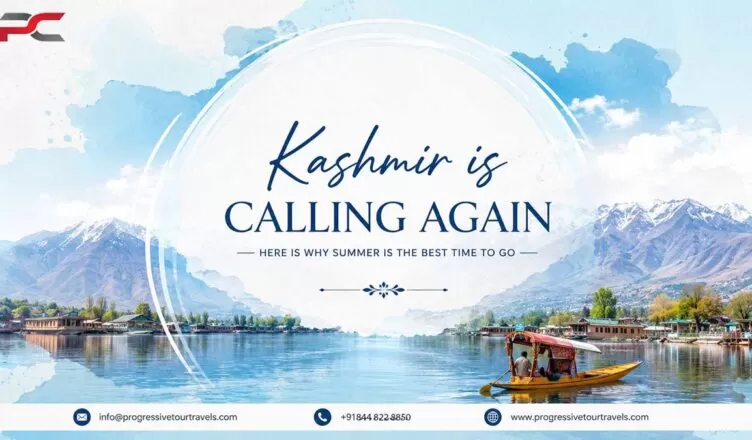
Every season in Kashmir is beautiful. But summer- June, July, August is when Kashmir becomes something else entirely. The meadows of Gulmarg are carpeted in wildflowers. The Pahalgam river runs jade-green over polished boulders. The Dal Lake shimmers in sixteen colours of dawn. The Mughal Gardens are in their fullest, most opulent bloom. And the temperatures? A merciful 15–25°C while the rest of India bakes. Summer is not just a good time to visit Kashmir. For most travellers, it is the best.
After years of uncertainty, Kashmir’s tourism is back and how. The infrastructure has improved dramatically. New hotels and boutique properties have opened. Airfares are more competitive than ever. And the Kashmiri people- warm, generous, extraordinarily proud of their homeland are welcoming visitors with open arms.
This guide from Progressive Tour & Travels will tell you exactly where to go, what to do, why summer is best time to go Kashmir and how to plan the perfect summer Kashmir trip this year or next year as a family, a couple, a group of friends, or a solo traveller.
“If there is a paradise on Earth, it is here, it is here, it is here.” — Emperor Jahangir on Kashmir. He was right.
Why Summer is Kashmir’s Finest Season
Let us address the most common misconception first: many Indian travellers believe winter is the ideal time for Kashmir. But unless you specifically want the snow experience (which is extraordinary in its own right), summer- May through August offers the most complete, comfortable, and visually spectacular Kashmir experience.
| Season | Temperature | Landscape | Crowd Level | Activities |
|---|---|---|---|---|
| Summer (Jun–Aug) | 15–28°C | Green meadows, wildflowers, full rivers | High but manageable | All activities open |
| Spring (Apr–May) | 10–22°C | Tulip blooms, fresh green | Very High (tulip season) | Most activities open |
| Autumn (Sep–Oct) | 8–20°C | Golden Chinar trees | Medium | Most activities open |
| Winter (Nov–Feb) | -8°C to 8°C | Snow-covered, magical | Low–Medium | Skiing, snowfall experience |
Summer wins because it is the only season when everything is accessible- Sonamarg, Gulmarg’s higher reaches, the Betaab Valley, Aru Valley, Yusmarg, Doodhpathri- all open simultaneously. The weather is ideal for outdoor activities, children and elderly travellers are comfortable, and the landscape is at its most vivid and dramatic.
Where to Go: The Essential Summer Kashmir Destinations
1. Srinagar- The Heart of the Valley
No Kashmir trip is complete without spending at least 2–3 nights in Srinagar. Stay in a traditional houseboat on Dal Lake for at least one night- the experience of waking up on the water, with the snow-capped Zabarwan mountains reflected in the lake and a Kashmiri breakfast arriving by shikara (wooden boat), is quintessentially Kashmir.
Summer is the ideal time for Srinagar sightseeing. The Mughal Gardens– Shalimar Bagh, Nishat Bagh, and Chashme Shahi- are in full bloom, with terraced formal gardens, cascading fountains, and an abundance of roses, irises, and dahlias. The Dal Lake shikara ride in the early morning is a meditative experience. The Hazratbal Shrine and the old city’s timber-frame architecture deserve half a day each.
Don’t miss: A floating vegetable market on Dal Lake at 5 AM — one of the most atmospheric sights in all of India.
2. Gulmarg — The Meadow of Flowers
At 2,650 metres above sea level, Gulmarg is one of the world’s most spectacularly situated destinations. In summer, the ski slopes that drew visitors in winter transform into vast alpine meadows carpeted with hundreds of species of wildflowers- primulas, geraniums, forget-me-nots, and the valley’s namesake gul (flowers). The name Gulmarg literally means “Meadow of Flowers,” and in summer, it fully earns it.
The Gulmarg Gondola– Asia’s highest and longest cable car- operates in summer, taking you from Gulmarg (2,650 m) to Kongdori (3,100 m) and then to Apharwat Peak (3,980 m). From the top, the views of the Pir Panjal range and the distant Nanga Parbat (8,126 m)- the world’s ninth-highest mountain are staggering. Summer trekking in Gulmarg is excellent- the Alpather Lake trek (5 km from Kongdori, passing through lingering snowfields) is a favourite.
Best activity: Horse riding through the flower meadows. Children absolutely love it.
3. Pahalgam — The Valley of Shepherds
Pahalgam sits at the confluence of the Lidder River and Sheshnag Lake at 2,130 metres — and in summer, it is one of the most beautiful places in India and Asia. The Lidder River runs clear and fast through pine-forested valleys, and the surrounding meadows -Aru, Betaab Valley, Baisaran are genuinely breathtaking.
Betaab Valley (named after the 1983 Hindi film shot here) is a broad, sun-filled meadow ringed by pine forests and snow-capped peaks — perfect for families with children. Aru Valley is quieter and wilder, with excellent trekking trails leading toward Kolahoi Glacier. Baisaran — nicknamed Mini-Switzerland — requires a short horse ride and rewards you with an open meadow with panoramic mountain views.
Pahalgam is also the base camp for the annual Amarnath Yatra, one of the most important Hindu pilgrimages, which takes place in summer (typically July–August). Pilgrims and tourists co-exist with ease.
4. Sonamarg — The Meadow of Gold
Sonamarg, at 2,740 metres on the way to Ladakh, has a different character from Gulmarg and Pahalgam — wilder, more dramatic, less commercialised. In summer, the snow on the surrounding peaks melts into dozens of streams that cut through the Thajiwas Glacier meadow. A short trek (or pony ride) takes you to the Thajiwas Glacier itself — where children can see and touch real glacier ice in July.
The drive to Sonamarg via the Sindh Valley is spectacular — the river changes colours from turquoise to jade to silver depending on the light, and the mountains grow progressively more dramatic as you climb. Sonamarg is best done as a day trip from Srinagar (85 km, ~2.5 hours) or as an overnight stay.
A Perfect 7-Day Kashmir Summer Itinerary
Day 1
Arrive Srinagar — Land at Sheikh ul-Alam International Airport. Transfer to your Dal Lake houseboat. Evening shikara ride on the lake. Dinner on board: Rogan Josh, Dum Aloo, Kashmiri bread (kulcha).
Day 2
Srinagar Sightseeing — Morning: floating vegetable market and shikara ride. Mughal Gardens — Shalimar Bagh, Nishat Bagh (peak bloom in June). Afternoon: Shankaracharya Temple for panoramic valley views. Evening: old city walk and Hazratbal Shrine.
Day 3
Srinagar → Gulmarg (Day Trip) — Drive to Gulmarg (56 km, ~1.5 hours). Gondola ride to Kongdori. Wildflower meadow walk. Horse riding. Optional: Alpather Lake trek. Return to Srinagar for the night.
Day 4
Srinagar → Sonamarg → Srinagar — Full-day drive to Sonamarg via Sindh Valley. Thajiwas Glacier walk or pony ride. Riverside lunch. Return to Srinagar. Overnight: hotel near Dal Lake.
Day 5
Srinagar → Pahalgam — Morning drive to Pahalgam (96 km, ~2.5 hours). Check in to riverside hotel. Afternoon: Betaab Valley and Aru Valley visit. Evening: stroll by the Lidder River.
Day 6
Pahalgam — Baisaran and Local Exploration — Morning: horse ride to Baisaran meadow (Mini Switzerland). Afternoon: local market shopping — Kashmiri shawls, saffron, walnut wood crafts, and dried fruit. Evening: bonfire and Kashmiri wazwan dinner.
Day 7
Pahalgam → Srinagar → Departure — Morning drive back to Srinagar. Last-minute shopping at Lal Chowk or the Boulevard. Depart from Srinagar airport.
✈️ Ready to plan your Kashmir summer trip? Talk to our Kashmir travel specialists at Progressive Tour & Travels- customised itineraries, group bookings, and Kashmir family tour packages available.
Month-by-Month Summer Weather Guide for Kashmir
May
12–24°C
Tulips fading, wildflowers beginning. Crowds thin. Pleasant.
June
15–27°C
Peak blooms. Best weather. Mughal gardens spectacular. Busy.
July
17–28°C
Lush green meadows. Amarnath Yatra season. Great for trekking.
August
15–26°C
Slightly wetter in Srinagar. Rivers full. Meadows pristine. Fewer tourists.
September
10–22°C
Chinar trees turn gold. Apple orchards in harvest. Stunning.
October
6–18°C
Peak autumn foliage. Cooler. Some high-altitude roads closing.
Kashmir Summer: The Food You Must Eat
Kashmiri cuisine is one of India’s most distinctive and celebrated culinary traditions — rich, aromatic, warming, and deeply satisfying. A summer trip is the perfect opportunity to explore it fully.
- Wazwan — The grand Kashmiri feast: 36 dishes served in a single sitting, centred around Rogan Josh, Yakhni, Gushtaba, and Seekh Kabab
- Kahwa — Kashmiri green tea with saffron, cardamom, and almonds — drink it at every opportunity
- Dum Aloo Kashmiri — Potatoes in a deeply spiced yoghurt gravy, unlike any Dum Aloo you have eaten elsewhere
- Modur Pulao — Sweet saffron rice with dry fruits — a revelation
- Kulcha with Noon Chai — Kashmiri bread with the famous pink salt tea (an acquired taste, but you will acquire it)
- Fresh trout — Grilled river trout from Pahalgam or Sonamarg is a summer highlight
- Saffron kulfi — Made with Kashmir’s own saffron, the most expensive spice in the world
What Makes Kashmir Different in Today’s Time?
Kashmir has undergone remarkable transformation in recent years. Infrastructure investment has been significant — the Banihal-Banihal rail tunnel and Banihal-Qazigund road tunnel have dramatically cut travel times within the valley. New boutique hotels and luxury tented camps have opened across Gulmarg, Pahalgam, and Sonamarg. The Srinagar airport has been upgraded. Connectivity has improved dramatically.
Perhaps more significantly, the atmosphere in Kashmir has changed. Visitor numbers have surged over the past three years, bringing economic energy and a renewed sense of pride in the Valley’s extraordinary tourism potential. Locals — from shikara wallahs to shopkeepers to hotel staff — are enthusiastic, welcoming, and genuinely proud to show visitors what Kashmir is and has always been: a place of incomparable beauty.
Travel Safety Note: Kashmir is safe for tourists. The Indian government and local tourism authorities have invested heavily in visitor safety and infrastructure. Millions of tourists visit each year without incident. As with any travel destination, exercise standard precautions, follow local guidance, and book through established operators like Progressive Tour & Travels who know the region.
Things to Do in Kashmir This Summer: Beyond the Obvious
- Trout fishing in Pahalgam — The Lidder River is famous for brown trout. Permits available locally.
- Lavender farm visit, Doda district — June sees Kashmir’s lavender fields in bloom, a relatively new but spectacular attraction.
- Cooking class in a Srinagar home — Learn to make Rogan Josh or Kahwa with a Kashmiri family.
- Nagin Lake kayaking — Quieter than Dal, Nagin Lake is excellent for kayaking and stand-up paddleboarding.
- Village walk in Dachigam — On the outskirts of Srinagar, Dachigam National Park is home to the critically endangered hangul (Kashmir stag).
- Star gazing at Sonamarg — At 2,740 m with minimal light pollution, Sonamarg offers outstanding stargazing.
- Saffron field visit, Pampore — Just 15 km from Srinagar, Pampore is the saffron capital of India. While the blooming season is October–November, the fields and processing cooperatives are fascinating year-round. If you are looking for more information before trip planning, find all in this Kashmir Travel Guide.
Frequently Asked Questions
Is Kashmir safe to visit now a days?
Yes. Kashmir is safe for tourists and receives millions of visitors every year. Government security infrastructure is robust, and the tourism sector is thriving. Book through a reputable operator and follow standard travel precautions. Contact Progressive Tour & Travels for current on-ground travel advisories.
Which month is best for visiting Kashmir in summer?
June is the single best month- the Mughal Gardens are in peak bloom, the weather is ideal (15–27°C), Gulmarg meadows are spectacular with wildflowers, and all destinations are fully accessible. July is excellent for trekking and river activities. August has fewer tourists and deeply green landscapes.
How many days are enough for a Kashmir trip?
6–7 days is the minimum for a comprehensive Kashmir trip covering Srinagar, Gulmarg, Pahalgam, and Sonamarg. Extend to 9–10 days if you want to add Yusmarg, Doodhpathri, or a Ladakh extension.
Is Kashmir a good summer destination for families with children?
Absolutely. Kashmir in summer is one of India’s best family destinations- the weather is perfect, there is no extreme cold to manage, activities like pony riding, gondola rides, and meadow walks delight children, and the cuisine is diverse and mild enough for younger palates.
What is the best way to reach Kashmir?
Flying into Srinagar is the most practical option- the airport is well-connected to Delhi, Mumbai, Bangalore, Kolkata, and other major cities. Road entry via Jammu (through Banihal tunnel) is an option for those combining Jammu with Kashmir. If you are looking for a family trip to Kashmir, got for Force Urbania on Rent which makes long trip comfortable and convenient.
Why Kashmir Should Be on Your Travel List
There are very few places in the world where natural beauty, cultural richness, spiritual depth, and culinary excellence converge so completely. Kashmir in summer is that rare destination- one that genuinely delivers more than your expectations, regardless of how high you set them.
The morning mist rising from Dal Lake. The wildflowers of Gulmarg swaying in the breeze. The sound of the Lidder River over smooth stones in Pahalgam. A cup of Kahwa at 3,000 metres, looking out at the Himalayas. These are not travel experiences. They are life experiences.
And now — with improved infrastructure, better connectivity, and a warm wave of Kashmiri hospitality welcoming the world back — there has genuinely never been a better time to go.
Great post! Anyone planning a group trip should consider a Tempo Traveller for Outstation for a comfortable and affordable travel experience. Thanks for sharing!